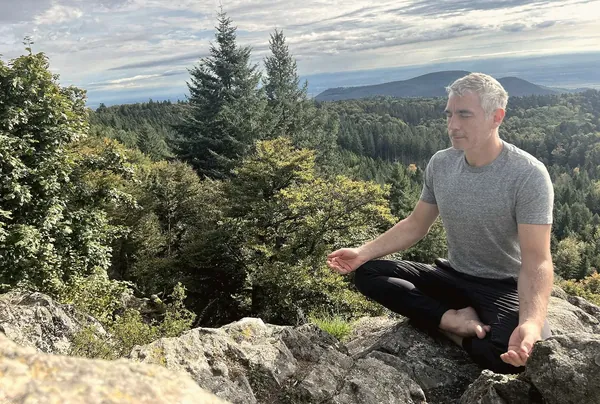
I want to start with who I was before.
I was an angry person. Not violently, not obviously — but persistently. I carried a grudge against the world. Things happened to me; I stored them. Small slights, old wounds, the general friction of being alive among other people — I held all of it, tightly, and it colored every decision I made. I reacted fast and reflected slowly. I burned bridges without quite meaning to. I was, in a word I now use without shame, difficult.
I don't remember exactly why I started meditating. There was no dramatic moment, no rock bottom. I think I was tired of myself. I sat down one morning, set a timer for ten minutes, and tried to be quiet. It was uncomfortable and unimpressive. But I did it again the next day.
What silence teaches you that nothing else does
The changes were so gradual that I almost didn't notice them. There was no single morning when I woke up transformed. It was more like the way a river slowly reshapes stone — not an event, but a direction.
After a few months, I noticed I was pausing before reacting. A moment — half a second, sometimes less — between what happened and what I did. That gap was not there before. It sounds small. It changed everything.
After a year, I noticed I was making better decisions. Not because I had become wiser in any dramatic sense, but because I was less frightened. The anger, I came to understand, had always been fear in disguise. Fear of being wrong. Fear of being diminished. Fear of not mattering. When the silence started to loosen that fear, the decisions that followed were cleaner.
I stopped carrying the weight of things that were already over. Not all at once. Slowly, and then one day I noticed the weight was gone.
After three years, I stopped holding grudges. This surprised me more than anything else. I had thought the resentment was just part of who I was — a feature, not a bug. It wasn't. It was a habit, and like all habits, it could be changed. The silence gave me the space to see it clearly enough to let it go.
The ceiling of solo practice
By year five or six, I had settled into something steady. The practice was quiet and reliable, like a compass that always pointed somewhere useful. But I also began to notice something: I had reached a kind of ceiling.
Sitting alone, I could go deep. I could arrive at a quality of presence that felt genuine and nourishing. But it also felt, at times, like a closed loop. Something I was doing for myself, by myself, to myself. And there was a question that started to surface in the silence: is this enough? Is the silence more powerful when it is shared?
I started reading about group meditation — studies on synchronized practice, accounts from contemplative traditions, reports from people who had attended silent retreats. What I found was consistent: sitting together changes something. Not just the social texture of the experience, but the quality of the silence itself.
I thought about Quaker meetings — gatherings built entirely on collective silence, with no leader, no liturgy, just a group of people waiting together. I thought about Buddhist monasteries where monks meditate in the same hall at the same hour every day for decades. I thought about the particular quality of a library, or a forest, where the silence is held by many presences at once.
There is something different about silence that is shared. I don't know exactly what to call it. It has a texture that solo silence doesn't have.
The idea that became Awakhuma
The idea was simple: what if thousands of people could enter that shared silence together, every day, without needing to be in the same room?
Not a meditation course. Not a program with levels and rewards and streaks. Not something that asks you to become a particular kind of person before you can enter. Just a door. You show up at the time, you sit quietly, and you know that right now — in apartments and gardens and offices and trains across the world — other people are doing the same thing.
What I did not want to build was another productivity tool wearing the clothes of wellness. The meditation industry is full of those. Apps that promise to make you more focused, more successful, more optimized. There is nothing wrong with that. But it wasn't what the silence had given me, and it wasn't what I wanted to offer.
What the silence had given me was simpler and stranger: the ability to be present without needing things to be different. A quieter relationship with my own reactions. A way of moving through difficulty that didn't require suppressing it. These things are not optimizations. They are something older.
What Awakhuma is
Awakhuma is an attempt to make that available at a scale that wasn't possible before.
Four times each day — at 5:45, 11:45, 17:45, and 23:45 UTC — the app opens a window of shared silence. Eleven minutes. No voice, no music, no guidance. Just the knowledge that right now, others are here, in their own rooms, in their own silence, at the same time as you.
You can also sit alone, any time, for as long as you like. Solo practice is the foundation. But the collective sessions are the heart of it — the reason the app exists.
I don't know exactly what happens when a thousand people sit in silence at the same moment. I have theories, and there is research that points in interesting directions. But I am less interested in the mechanism than in the experience. People who try it — even skeptical people, even people who have never meditated before — often report something they didn't expect. A quality of presence. A feeling of not being alone in the quiet.
Small moments of silence, shared by many, change the rhythm of the world.
That is what I believe, after 3,500 days of sitting down and returning to silence. And it is why I built this.
If you are reading this, you are already somewhere near the door. Come in. The silence is waiting.
— Davy